When ChatGPT launched in 2022, and many were still using it for fun, Colgate-Palmolive (opens in a new tab) saw the writing on the wall. By mid-2023, it had its first Head of AI to develop a strategy to help teach its 34,000 employees how to work with technology that was evolving by the week.
Right away, the challenge was to deliver company-wide AI adoption that was safe and sustainable for an enterprise with people in 100 countries, selling its essential health and hygiene products in 200 countries and territories. It was clear that there was intense interest in the public and amongst their employee population. Colgate-Palmolive had a choice: they could try to restrict employees from building with AI, or they could build a system that empowered teams while maintaining robust safety and governance structures.
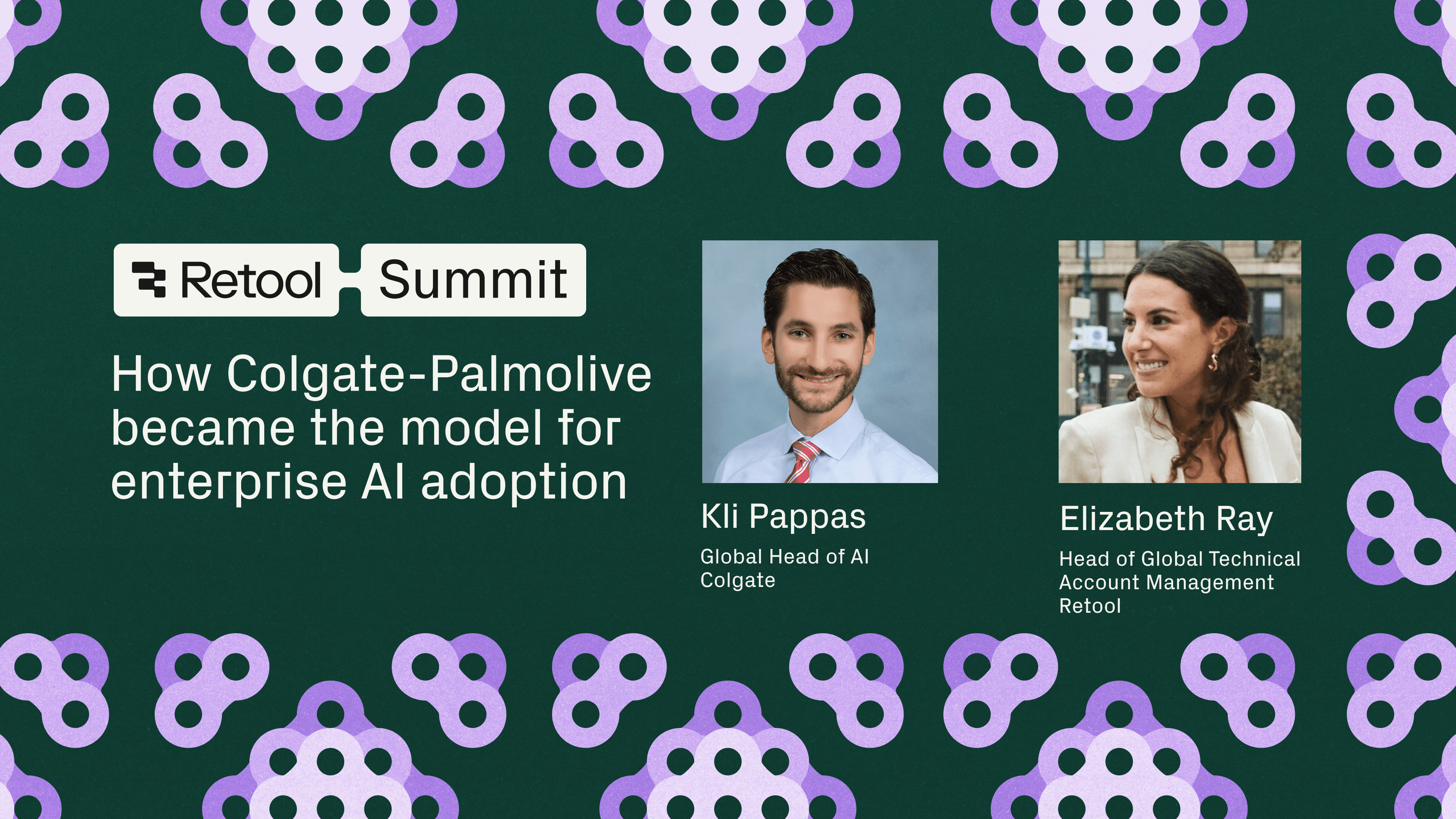
Kli Pappas, Global Head of AI at Colgate-Palmolive, sat down with Elizabeth Ray, Retool’s Head of Global Technical Account Management, at Retool Summit to share how Colgate-Palmolive launched an internal AI hub, empowered thousands of employees to build their own AI applications, and what other enterprises can learn from their approach to scaling enterprise AI adoption safely.
Deploying AI at scale: building Colgate-Palmolive’s internal AI hub
Legacy companies aren’t always known for risky tech bets, but Colgate-Palmolive—whose Colgate brand is in more homes than any other—quickly realized the risk of doing nothing. The company decided to expand employees’ access to AI, rather than immediately trying to limit or control it. Colgate-Palmolive now has its own AI hub—a safe environment that everyone in the company is encouraged to use.
Balancing risk and empowerment in enterprise AI adoption
Kli cited findings from the 2024 Work Trends Index (opens in a new tab): 75% of global knowledge workers were already using AI, and most of them reported using their own tools because their companies didn’t provide it to them.
“The fact is, the technology is available to everyone, it’s free, and it’s super powerful,” Kli says. “If you aren’t putting it in the hands of your employees, they could use it anyway and create risk for your organization.”
With 66% of software builders now working under AI mandates, according to Retool’s 2025 Builder Report, the tools builders have access to, and how those tools are governed, will determine their impact.
“Systems need to be configured in a way that the happy path is the easiest path,” Kli explains.
From training to custom GPTs
With the AI hub rollout came mandatory company-wide training. Then came custom GPTs using OpenAI’s Assistant API (opens in a new tab), which allowed everyone in the company to build AI-powered assistants of their own. There are processes in place if employees want to share their assistants to a small group or a broader group.
Thousands of people built AI assistants. The majority were made for individual or small-group usage, but about 10% were deployed to entire business lines.
“It was incredible to see how many people wanted to be builders, had a problem to solve and really just needed the platform and some guardrails that let them play first and have a pathway to get it approved,” Kli says.
This internal hub became the foundation of Colgate-Palmolive’s enterprise AI strategy—centralizing safe access, governance, and experimentation.
Why AI-powered app building transforms business operations
Enterprise software used to require painstaking custom builds or implementing blanket solutions that don’t quite solve every department’s challenges. AI, and especially enterprise AppGen, changes that.
For the team at Colgate-Palmolive, democratizing software building means empowering domain experts with the right tools and constraints. One use case was plant managers using LLMs to translate important documents.
“I want the people closest to the problem to be engaged in building the solution,” Kli says. “Most of the work that happens day-to-day happens between the people who do it.”
Translating business-critical documentation at scale
One early way Kli saw his team using AI on the ground was for quick language translation.
“We had people who were manufacturing facility managers, for example, using a language model to instantly translate technical manuals from German to Greek, to answer operational questions in real time,” Kli explains. “That was an inspiring use case.”
Now, with enterprise AppGen, teams at Colgate-Palmolive can operationalize work, like capabilities for Frontline workers while maintaining the security, governance, and compliance standards the larger organization requires. The platform’s role-based access control means IT can set appropriate boundaries. And pre-built integrations and components mean builders can focus on solving business problems rather than wrestling with infrastructure.
What makes AI apps “enterprise-ready”
Enterprise-ready AI apps include built-in governance, security, and role-based controls so teams can innovate safely without compromising compliance.
AI enablement is going to look different at a 30,000-person enterprise than at a 300-person tech startup. Kli’s team was responsible for helping the company rethink its entire approach to governance. When evaluating AI solutions, Colgate-Palmolive’s requirements were non-negotiable: role-based access control, secrets management, ready-made templates, and governance workflows to meet its Responsible AI commitments (opens in a new tab).
“We may not be a tech company, but we’re a caring, innovative growth company that is reimagining a healthier future for all. So our technical team has a huge mandate,” Kli says. “We have to bring capabilities to a large number of people around the world.”
Instead of restricting employee access, Kli knew that true enterprise-readiness couldn’t come from the bottom up. The company had to safely scale AI by balancing compliance, governance, and speed, and implementing guardrails for individual builders to ensure teams were building apps responsibly.
Navigating internal AI regulations and rapid tech changes
Fast-moving tech necessitates equally fast-moving and complex internal regulations. These new builders lack the specialized training that engineers get—building with security in mind, managing sensitive information properly, and understanding deployment implications.
“External regulations are based on the use case, not the technology,” Kli points out. “It’s not ‘does the software meet a standard,’ it’s ‘does this use meet a standard.’”
This creates particular challenges for developing internal policies while driving enterprise adoption. Training builders about the differences between low risk use cases (e.g. asking ChatGPT to make PowerPoint recommendations) and high risk use cases (e.g. asking ChatGPT to review resumes and make hiring recommendations), is an organizational imperative.
Creating enterprise AI systems where domain experts can thrive
For Colgate-Palmolive, this reality shaped how they thought about expanding their builder base. Domain experts—the manufacturing facility managers, the customer development teams, the operations staff—understand the nuances of their work better than any central IT team ever could. But not everyone is an expert on tech and policy.
“People who are going to use these AI tools and bring scale don’t always know what they need to know,” Kli acknowledges. And that’s by design. Every new builder doesn’t suddenly need to be a policy expert. It’s on enterprises to create systems where builders can focus on solving business problems while the platform handles the guardrails.
As Colgate-Palmolive scaled, AI governance became central, ensuring every builder could innovate without introducing risk.
Overcoming internal challenges to enterprise AI adoption
In large organizations, navigating new technology adoption is difficult because of existing ways of working. The different groups responsible for managing risk and driving innovation often have competing priorities, creating a natural tension that can stall AI adoption.
When there is an evolving business, legal and regulatory landscape, it is easier for teams to default to “risk” as being a reason not to push for transformational change. But not taking calculated risks in the AI space ignores growth potential.“ Kli’s team combats this by making sure that teams understand the risk of inaction.
“Companies are letting the frog get boiled,” he warns. “I think a lot of companies are stuck in this incrementalism phase where they just feel like things will move and ‘we’ll get there.’ And I don’t think that that’s how AI is going to play out at all.”
Incrementalism is where things get stuck, but every indicator says AI’s impacts won’t be incremental. The amount of investment flowing into AI capabilities, the speed of technological change, and even government involvement all suggest rapid transformation ahead.
“Leaders across businesses, including legal, compliance, and IT professionals, working collaboratively, need to treat this like a once-in-a-generation change, and that means considering business model risk, including risk from inaction,” Kli says. “We have great opportunities if we take calculated risks while moving quickly.”
Redefining risk at the enterprise level
At Colgate-Palmolive, they consider business model risk from inaction as a key concern. This risk needs to be balanced with other risks from bringing in AI, including the need for human oversight, data governance, compliance with laws and regulations and security concerns.
Getting company-wide AI adoption in the enterprise
AI processes are only transformed if everyone is transforming. Colgate-Palmolive is a large company, and many teams work together across the business.
“If half the team knows what technology can do for it and the other half doesn’t, that’s a non-functional team,” Kli notes. “Imagine you have a team, and half the people know what Google Sheets is and half the people don’t know what Sheets is. You can’t work together because your conception of how much time it takes to do different tasks, how you sequence things and who does what completely falls apart.”
This is particularly true when it comes to AI tools and natural language processing capabilities. When half a team understands what they can do with an agent or AI workflow and language models, and half don’t, the team can't function effectively.
Training everyone, not just builders
Colgate-Palmolive rolled out company-wide education to close this gap:
- Mandatory online training for everyone
- Optional advanced online training
- Small group, community-led training programs
The organization now has AI leads globally, each with a dozen ambassadors on their teams who have gone through “train the trainer” programs. These local experts show smaller groups what they can do with AI tools, running hundreds of sessions so far with groups of 10 to 50 people.
“People are curious about AI and what it means for them,” Kli says. “So we put people in the driver’s seat and give them the training and tools they need to succeed.’”
Making AI education human and local
The training is focused on being “Super You”—underscoring for teams that you are in control of your own destiny with AI. Today, ambassadors learn how to build agents in Retool themselves, then train others.
Investing in programs like these can seem daunting for organizations earlier along in their AI journey, but the seriousness of AI demands this level of change. It’s up to enterprises to set their teams up for success.
Governance was only one part of scaling; widespread literacy made enterprise AI sustainable.
The future of enterprise AI AppGen at Colgate-Palmolive
Kli’s team is partnering with Retool to update Colgate-Palmolive’s AI hub, focusing on three strategic pillars: marketing, innovation, and operations.
- Marketing uses generative AI for certain concept and content creation.
- Innovation focuses on new products as growth drivers.
- Operations targets supply chain efficiency and productivity improvements.
Centralizing Retool Agents throughout the organization is also on the roadmap. Like the AI hub concept, Kli’s team wants to create a discoverability platform where people can find agents and build toward a multi-agent architecture.
“The dream is that those agents are individually effective but they can all communicate via agent-to-agent [communication]. Then we can start to build these much more complex agent-to-agent structures that do much more complicated things,” Kli explains.
On the operations side, there are limitless opportunities for automation. “There’s a lot of data work and a lot of intelligence-type reporting that we think agents can do a significant amount of,” he says.
The vision is a multi-agent architecture where agents built by process owners—the people who understand the work best—can communicate, collaborate, and keep humans in-the-loop to handle increasingly complex tasks.
Key lessons for scaling enterprise AI adoption
Kli’s experience scaling AI at Colgate-Palmolive offers valuable lessons for any enterprise looking to expand AI capabilities:
Opt for guardrails over outright restrictions on AI use
If everyone’s using AI anyway, they should use it within the company’s governed ecosystem. Give people the tools to build safely rather than trying to prevent them from using AI at all. Make sure they know the relative risk of their use case (low vs. high) and take appropriate steps to mitigate the risk.
Invest in enterprise-wide AI education
Company-wide AI literacy isn’t optional. If only part of your team understands these tools, you’ve created dysfunction, not opportunity. Make training mandatory, but make it local and relevant.
Choose platforms that scale with your builders
You need tools that work for both novice builders and experienced engineers. Enterprise AppGen platforms provide the right level of abstraction—enough guardrails for safety, enough flexibility for power users.
Empower domain experts to drive success closest to the problem
The best solutions come from domain experts who understand the nuances of the work. Give them tools that let them build without requiring years of engineering training.
Having the best AI models won’t matter if you can’t get them into the hands of people who actually know the work.
Ready to see how enterprise AppGen can work for your organization? Try Retool for free.